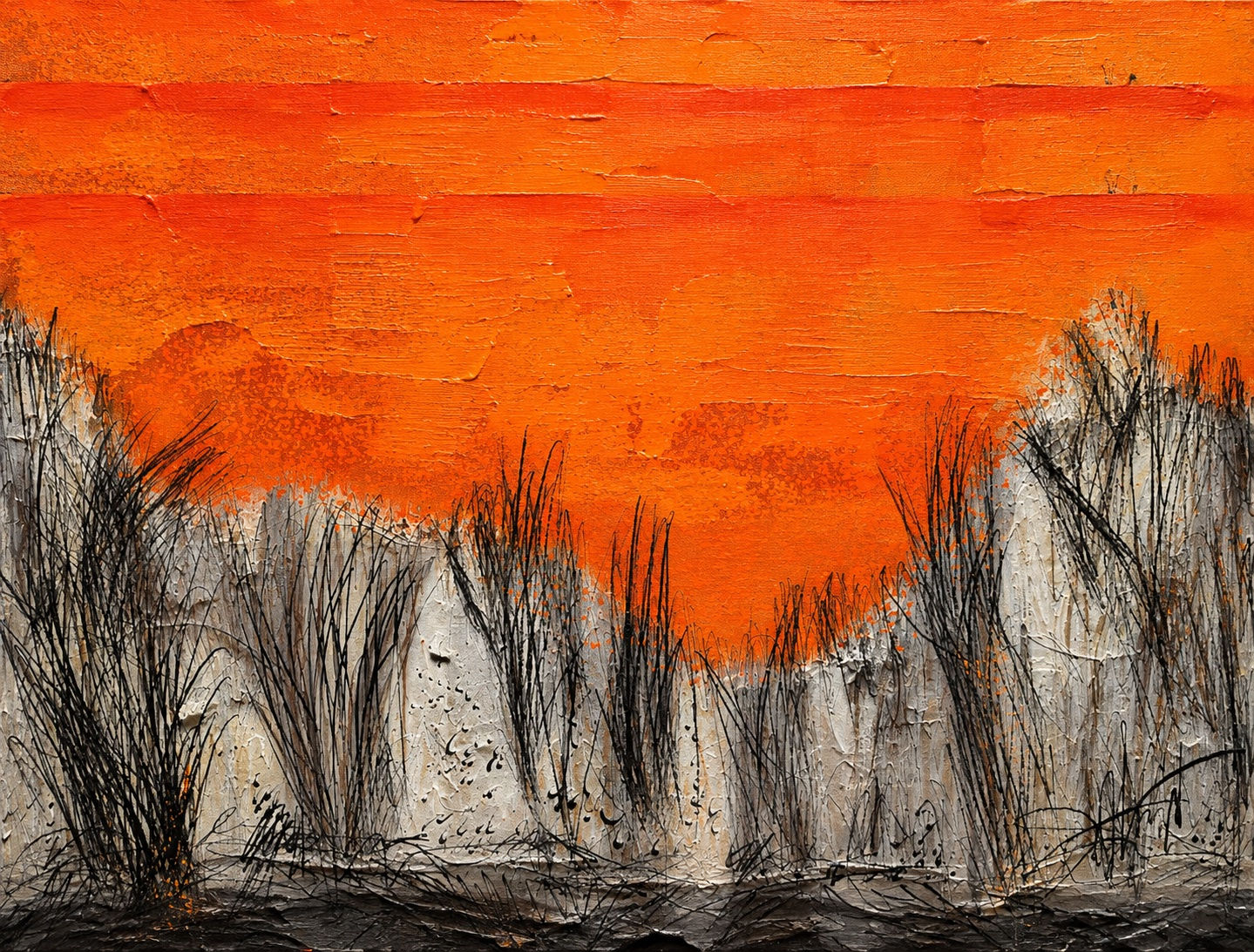
Where the Wild Things Rise
n Where the Wild Things Rise, Jefferey Cornett reduces the idea of landscape to its emotional essentials: earth, growth, horizon and an almost overwhelming field of orange sky.
The upper portion of the composition is unapologetically orange. Rather than functioning simply as background, it becomes an environment of its own. Bands of slightly different oranges move horizontally across a heavily textured surface, creating something that can read alternately as sunset, heat, memory or an immense wall of color. Subtle variations interrupt the field, preventing what initially appears simple from ever becoming completely still.
Against that expansiveness, the lower third becomes wonderfully restless.
Ivory, gray, charcoal and black forms rise unevenly from the bottom edge. Some resemble buildings. Others suggest rock formations, winter grasses, reeds or trees stripped of their leaves. Cornett refuses to resolve them completely. The viewer's mind continually moves between landscape and abstraction.
The thin black marks are particularly important. They have the immediacy of drawing—almost as though someone has taken charcoal directly to the surface after the broader areas of color have been established. They scratch, climb, intersect and occasionally seem to collapse into one another. Against the monumental orange field, these marks feel fragile but remarkably persistent.
That tension gives the work its emotional center.
Everything below appears vulnerable. Everything below continues to grow.
There is also a compelling reversal of conventional landscape painting. Ordinarily, the sky provides breathing room around the subject. Here, the orange seems to press downward. The vegetation—or city, or community—must push upward against it.
That makes the work considerably more than an orange landscape. It can become a painting about resilience, persistence and the complicated beauty of continuing to rise.
Within The Orange & Black Collection, I would position this as one of the quieter works conceptually, but potentially one of the more emotionally accessible. You don't have to understand abstraction to enter it. From across a room it is dramatic; from several feet away, the surface and black gestural marks reveal an entirely different experience.
Provenance
For the Gallery's records, I would establish the provenance conservatively and only state facts that can actually be documented:
Provenance:Created by Jefferey Cornett, 2026. From the artist's Orange & Black Collection. Retained in the artist's collection following creation and subsequently represented by The Distelheim Gallery, LLC. Private collection of the artist until sold.
Exhibition/Presentation History:Private viewing, The Distelheim Gallery, 2026.Additional exhibitions, publications and presentations should be added to the permanent provenance record as they occur.
Collection: The Orange & Black Collection
Artist: Jefferey Cornett
Representation: The Distelheim Gallery, LLC
Date: 2026
Status: Master Work / Unique Work
Edition: 1/1
Certificate: Certificate of Authenticity issued by The Distelheim Gallery, LLC.
I would also assign it a permanent inventory number such as:
DG-JC-OB-WWR-001
Suggested Gallery Valuation
This is important: a gallery asking price is not the same thing as an independent appraisal or established fair-market value. For Cornett's developing primary market, pricing should reinforce consistency across the Orange & Black Collection rather than jump dramatically based solely on our visual assessment.
For a substantial, professionally produced, signed one-of-one master work, I would position Where the Wild Things Rise at:
Suggested gallery retail: $15,000.
For a very large museum-scale presentation—particularly around 60 × 72 inches or larger, with museum-quality archival fabrication, excellent finishing, COA and documented exhibition history— Gallery presenting it at approximately $17,500–$22,500 as Cornett's sales and exhibition record develops.


